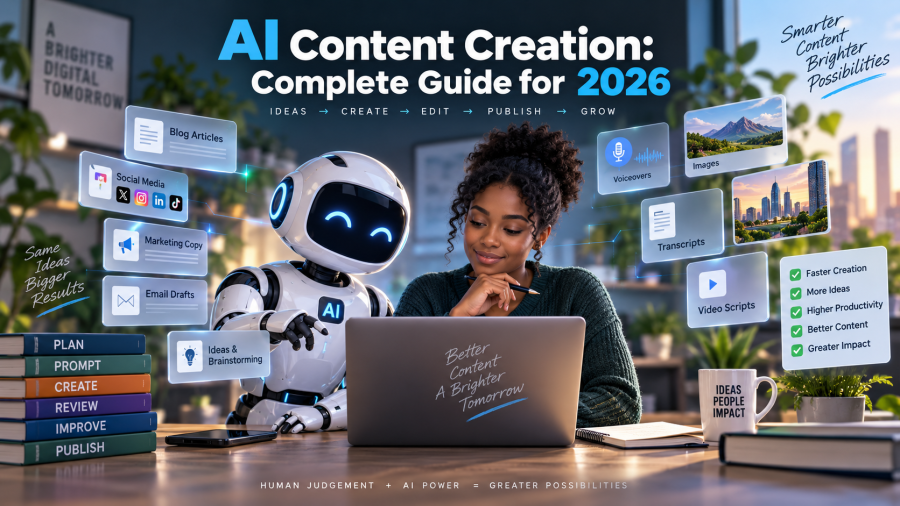
AI Content Creation: Complete Guide for 2026
Artificial intelligence has changed the way people create, edit and distribute digital content. What once required several hours of research, writing, design and editing can now be assisted by AI tools within minutes.
From blog articles and social media posts to images, voiceovers, transcripts and marketing copy, AI can support almost every stage of the content creation process.
But using AI effectively is not simply a matter of entering a prompt and publishing whatever it produces. The quality of the final result depends on the instructions provided, the tools used, the information supplied to the AI and the amount of human review applied afterwards.
This guide explains what AI content creation is, how it works, what types of content can be created with AI, its advantages and limitations and how to build a reliable AI assisted content workflow in 2026.
What Is AI Content Creation?
AI content creation is the use of artificial intelligence systems to assist with producing digital content.
Depending on the technology being used, AI can generate or help develop:
- Blog articles
- Website copy
- Product descriptions
- Social media posts
- Advertising copy
- Email drafts
- Video scripts
- Images
- Voiceovers
- Audio transcripts
- Summaries
- Brainstorming ideas
- Marketing concepts
- Chat responses
Modern AI systems can understand natural language instructions and generate content based on a user’s prompt. Some systems can also analyse uploaded information, transform existing content, create images from descriptions or convert speech into text.
AI therefore works best as a content creation assistant rather than as a replacement for judgement, expertise and editorial review.
How Does AI Content Creation Work?
Although different AI systems use different technologies, the basic workflow is relatively simple.
1. The user provides an instruction
The process begins with a prompt.
For example:
Write a 1,000 word article explaining how solar panels generate electricity for secondary school students.
The quality of the instruction affects the usefulness of the response.
A vague prompt may produce a generic answer, while a detailed prompt can provide the AI with information about the audience, purpose, tone, structure and desired outcome.
2. The AI interprets the request
The AI system processes the instruction and determines what the user is asking it to produce.
Modern generative AI models can identify relationships between words, concepts and patterns learned during training.
3. The system generates an output
The AI then produces an output that matches the request.
Depending on the tool, this could be:
- Text
- An image
- Audio
- A transcript
- A summary
- A conversation
- A structured document
4. The user reviews the result
This stage should never be ignored.
AI can produce incorrect information, outdated information, misleading statements or content that sounds convincing but lacks sufficient evidence.
The user should therefore review the output for:
- Accuracy
- Relevance
- Originality
- Clarity
- Grammar
- Factual correctness
- Appropriate tone
- Copyright considerations
- Compliance with applicable rules
5. The content is edited and published
After review, the content can be refined and prepared for its intended audience.
This human review stage is one of the most important parts of responsible AI content creation.
What Types of Content Can AI Create?
AI content creation has expanded far beyond simple article writing.
AI Written Content
AI writing tools can assist with:
- Blog posts
- Articles
- Website pages
- Product descriptions
- Emails
- Advertisements
- Social media captions
- Video scripts
- Newsletters
- Business documents
- Brainstorming
- Outlines and summaries
For example, a business owner could provide information about a product and ask an AI writing tool to create several product description drafts.
The business owner can then check the claims, select the strongest version and edit it to reflect the company’s actual brand voice.
AI Image Generation
Generative AI can create images from text descriptions.
A user might describe a scene such as:
A modern African city at sunset with solar powered buildings and electric buses, realistic photography style.
The system can interpret the description and produce a corresponding image.
AI image generation can be useful for:
- Blog illustrations
- Social media graphics
- Marketing concepts
- Product concepts
- Educational materials
- Presentations
- Creative projects
- Website visuals
However, users should understand the licensing and commercial use terms associated with the particular AI image service they use.
Text to Speech
Text to speech technology converts written words into spoken audio.
It can be useful for:
- Voiceovers
- Educational content
- Accessibility
- Podcasts
- Videos
- Narration
- Presentations
The quality of synthetic voices has improved considerably, but pronunciation, emphasis and tone can still vary depending on the language, voice and text.
Speech to Text
Speech to text technology converts spoken language into written text.
It can help users turn:
- Interviews into transcripts
- Lectures into notes
- Meetings into written records
- Voice recordings into text
- Videos into transcripts
The quality of a transcript can be affected by background noise, accents, microphone quality, multiple speakers and the language being spoken.
AI Chat and Assistants
AI chat systems can help users brainstorm ideas, explain concepts, draft responses, organise information and work through problems.
They can also be integrated into specialised workflows for businesses and other organisations.
However, important decisions should not be based solely on an AI response without appropriate human verification.
What Are the Benefits of AI Content Creation?
AI can provide several practical benefits when used properly.
Faster Content Development
One of the most obvious advantages is speed.
AI can quickly generate a first draft, outline, list of ideas or creative concept.
Instead of beginning with a blank page, a writer can start with an AI assisted draft and then improve it.
More Ideas
Content creators often struggle with generating new ideas.
AI can help brainstorm:
- Article topics
- Headlines
- Questions
- Content angles
- Campaign ideas
- Social media concepts
- Video topics
The creator still decides which ideas are useful.
Improved Productivity
AI can handle repetitive tasks and allow people to spend more time on activities that require judgement and creativity.
For example, a marketer might use AI to produce several initial advertising variations before selecting and editing the strongest ones.
Repurposing Existing Content
An existing piece of content can often be transformed into other formats.
A long article could become:
- Social media posts
- An email newsletter
- A video script
- A short summary
- Frequently asked questions
- Presentation points
This can make existing content more useful without requiring the creator to start from scratch.
Accessibility
AI powered speech and language technologies can make digital information easier to access.
Text to speech can help people listen to written material, while speech to text can make spoken information available in written form.
What Are the Limitations of AI Content Creation?
AI is powerful, but it is not infallible.
Understanding its limitations is just as important as understanding its capabilities.
AI Can Produce Incorrect Information
AI systems can generate statements that sound convincing but are incorrect.
This is particularly important when creating content involving:
- Science
- Medicine
- Law
- Finance
- Current events
- Statistics
- Historical claims
Important facts should therefore be checked against reliable sources.
AI Does Not Automatically Understand Your Business
An AI system may know general information about a subject but may not know the precise details of your company, customers or products.
Providing relevant context can significantly improve the output.
AI Generated Content Can Sound Generic
If thousands of people use similar prompts, the resulting content can sometimes have similar structures, phrases and ideas.
Human editing is therefore important.
Add:
- Personal experience
- Original examples
- Expert opinions
- Relevant data
- Specific case studies
- Unique insights
These elements make content more useful and distinctive.
AI Can Misunderstand Instructions
A prompt may be interpreted differently from what the user intended.
This is why users should inspect the output rather than assuming that the AI understood everything correctly.
AI Does Not Replace Expertise
A physics lecturer, doctor, engineer, lawyer or financial professional has specialised knowledge that cannot simply be replaced by asking an AI system a question.
AI can assist professionals, but responsibility for important decisions remains with appropriately qualified people.
How to Create Better Content With AI
The quality of AI assisted content depends heavily on the workflow.
Here is a practical approach.
Step 1: Define the Objective
Before opening an AI tool, decide what you want to achieve.
Instead of:
Write something about fitness.
Try:
Create an informative article explaining five practical ways beginners can build a consistent exercise routine. The audience is adults who have not exercised regularly. Use simple English and provide practical examples.
The second instruction gives the AI considerably more useful context.
Step 2: Define the Audience
Content written for a university professor should not necessarily sound like content written for a teenager.
Specify:
- Age group
- Knowledge level
- Industry
- Location where relevant
- Professional background
- Main problem
Step 3: Provide Context
Give the AI the information it needs.
For example, when creating product content, provide:
- Product name
- Features
- Target customers
- Price where relevant
- Main benefits
- Limitations
- Brand tone
- Important facts
The better the context, the less likely the output is to become generic.
Step 4: Ask for a Structure
For long content, it can be useful to request an outline before asking for the complete article.
A structure might include:
- Introduction
- Definition
- Main concepts
- Examples
- Advantages
- Limitations
- Practical applications
- Frequently asked questions
- Summary
The outline can then be reviewed before the full article is produced.
Step 5: Generate the First Draft
Once the objective and structure are clear, generate the initial content.
Do not assume the first response is the final version.
Treat it as a working draft.
Step 6: Fact Check
Check important claims independently.
This is particularly important when the article contains:
- Numbers
- Dates
- Statistics
- Scientific information
- Medical claims
- Legal information
- Financial information
- Names of organisations
- Current events
Step 7: Add Human Experience
This is where AI assisted content can become significantly more useful.
Add information that comes from genuine experience.
For example:
Instead of simply explaining how a product works, explain how your organisation uses the product, what users commonly struggle with and how those problems can be solved.
Step 8: Edit the Language
Remove unnecessary repetition and generic phrases.
Make the writing sound natural.
The goal should not be to make content look artificially human. The goal should be to make it genuinely useful to human readers.
Step 9: Add Supporting Material
Where appropriate, include:
- Original images
- Screenshots
- Examples
- Charts
- References
- Videos
- Case studies
- Downloadable resources
These can make an article considerably more useful.
Step 10: Publish Only When It Is Ready
Never publish AI generated content simply because the system produced it.
Publication should be the final step after review.
AI Content Creation and SEO
AI has changed content production, but search engine optimisation still depends on providing useful information to people.
Using AI to create an article does not automatically make the article good or bad.
What matters is the value of the final content.
A strong SEO article should:
- Address a genuine search need
- Answer the reader’s question
- Use clear headings
- Provide original information or useful synthesis
- Be factually accurate
- Be easy to read
- Have a logical structure
- Avoid unnecessary repetition
- Use descriptive titles
- Provide a good page experience
- Be supported by relevant internal links
Avoid creating hundreds of nearly identical pages simply because each page targets a slightly different keyword.
A smaller collection of genuinely useful articles can be more valuable than a large collection of thin pages.
How to Avoid Low Quality AI Content
One of the biggest mistakes in AI content creation is treating the AI output as the finished product.
Instead, use the following workflow:
Research → Prompt → Generate → Verify → Edit → Add Original Value → Publish
The most important stage is often the one between generation and publication.
Ask:
Is this accurate?
Does it answer the question?
Does it contain useful information?
Does it provide anything beyond generic statements?
Would I still publish this if search engines did not exist?
That last question is particularly useful.
If an article would provide genuine value to a reader even without search traffic, it is more likely to have a worthwhile purpose.
AI Content Creation for Businesses
Businesses can use AI throughout their content workflow.
Marketing
AI can help generate:
- Campaign ideas
- Advertising drafts
- Social media content
- Email campaigns
- Product descriptions
Customer Service
AI can help draft responses to frequently asked questions and support requests.
Sales
Sales teams can use AI to assist with:
- Email drafts
- Product explanations
- Meeting summaries
- Proposal drafts
- Customer research
E-commerce
Online stores can use AI to assist with:
- Product descriptions
- Category descriptions
- Promotional copy
- Social media content
- Product image concepts
Internal Communication
Businesses can also use AI to organise information, summarise documents and draft internal communications.
In each case, human review remains important.
AI Content Creation for Students and Educators
AI can also support education when used responsibly.
Students can use AI to:
- Brainstorm ideas
- Understand difficult concepts
- Create study questions
- Summarise material
- Improve grammar
- Develop revision notes
Teachers can use AI to:
- Create lesson ideas
- Generate practice questions
- Develop explanations
- Prepare drafts of educational materials
- Create classroom activities
However, AI should not be used to bypass academic requirements.
Students should follow the rules of their school or university and should not present AI generated work as their own where this violates academic policies.
How TextPixAI Supports AI Content Creation
TextPixAI is an AI powered content creation platform designed to bring several content creation capabilities together in one place.
Instead of switching between separate services for different tasks, users can access tools for areas such as:
- AI writing
- AI image generation
- Text to speech
- Speech to text
- AI chat
- Marketing content
- Social media content
For example, a content creator could use an AI writing tool to develop an article, generate an image to accompany it and then use text to speech to create an audio version.
The important principle remains the same: AI generates or assists with the material, while the user reviews the result and decides how it should be used.
What Makes a Good AI Content Creation Tool?
There are many AI platforms available, so choosing one can be difficult.
Consider the following factors.
Quality
Does the platform consistently produce useful results?
Variety
Does it provide the types of tools you actually need?
Ease of Use
Can you accomplish a task without unnecessary complexity?
Editing
Can you modify the generated content before using it?
Transparency
Does the provider clearly explain its terms, limitations and data practices?
Privacy
Understand what happens to your prompts, uploaded files and generated content.
Pricing
Compare the available plans with your actual usage rather than choosing solely based on the lowest price.
Reliability
A useful AI service should provide a dependable experience rather than frequently failing during generation.
Is AI Content Creation Replacing Human Writers?
Not completely.
AI changes the role of the writer rather than eliminating the need for writers in every situation.
A writer can use AI for brainstorming and drafting while concentrating on:
- Research
- Original ideas
- Expertise
- Editorial judgement
- Storytelling
- Accuracy
- Brand voice
- Audience understanding
The strongest approach is often a partnership between human judgement and machine assistance.
AI can help with speed and scale.
Humans provide context, judgement, experience and responsibility.
Is AI Generated Content Original?
Not necessarily.
AI systems generate content based on patterns learned during training and other information available to the system.
Different users can sometimes receive similar or overlapping outputs.
Therefore, users should not automatically assume that every AI generated sentence, image or idea is completely unique.
If originality is important, review the output, add your own contribution and check the applicable intellectual property and licensing rules.
Can AI Generated Content Be Used Commercially?
This depends on the AI service, its terms and the nature of the generated content.
Before using AI generated material commercially, check:
- The provider’s licence
- Commercial usage rights
- Restrictions on generated content
- Third party intellectual property
- Copyright requirements
- Applicable laws
Do not assume that every AI platform provides identical rights.
The Future of AI Content Creation
AI content creation is likely to become increasingly integrated into everyday software.
Rather than requiring users to open a separate AI application for every task, AI capabilities are increasingly being incorporated into:
- Writing software
- Design platforms
- Marketing systems
- Video editors
- Productivity applications
- Customer support systems
- Business software
The distinction between creating content and editing content is also becoming less obvious.
A user may begin with an idea, generate text, create an image, produce a voiceover and publish the final result within one connected workflow.
However, the increasing availability of AI also makes human judgement more valuable.
As AI generated material becomes easier to produce, useful content will increasingly depend on:
- Accuracy
- Original insight
- Experience
- Trust
- Relevance
- Clear communication
A Practical AI Content Creation Workflow
For everyday use, the following workflow is simple and effective:
1. Define the goal
Know exactly what you want to create.
2. Identify the audience
Understand who will consume the content.
3. Gather reliable information
Give the AI appropriate background information.
4. Write a detailed prompt
Specify the desired format, tone, length and purpose.
5. Generate a draft
Use AI to produce the first version.
6. Verify the information
Check important facts and claims.
7. Edit the output
Improve structure, clarity and accuracy.
8. Add original value
Include your experience, examples, data and insights.
9. Optimise for the audience
Make the content easy to understand and useful.
10. Publish and monitor
After publication, evaluate how people respond and improve the content where necessary.
Try each type of AI content on TextPixAI
If you want to put this guide into practice, each type of content above has a matching tool: the AI Writer with 60+ templates, the AI Image Generator, Text to Speech, Speech to Text and AI Chat. Whatever you create, Google's guidance on helpful, people-first content and its note on AI-generated content in Search are worth reading before you publish: Google rewards useful, original content however it is produced, and its spam policies cover low-value content produced at scale.
Related guides
Keep reading in this topic cluster:
- How to Use an AI Blog Ideas Generator (Step by Step)
- How to Use TextPixAI to Create Images and Articles
- How to Turn a Blog Post into Audio with AI Text to Speech
- Transcribe Voice Memos to Text Free: Easy Ways
- How Small Businesses Can Use AI: A Practical Guide
Frequently Asked Questions
What is AI content creation?
AI content creation is the use of artificial intelligence to assist with producing text, images, audio, transcripts and other forms of digital content.
Is AI content good for SEO?
AI can be used as part of an SEO content workflow, but simply generating large amounts of AI content does not guarantee search visibility. Content should provide genuine value, satisfy the user’s search intent and be accurate and useful.
Can AI write a complete article?
Yes. AI systems can generate complete article drafts. However, important articles should be reviewed, fact checked and edited before publication.
Can AI create images?
Yes. Generative AI systems can create images from text descriptions. The available styles, quality and commercial rights depend on the particular service.
Can AI create voiceovers?
Yes. Text to speech systems can convert written text into synthetic speech that can be used for narration, accessibility and other applications, subject to the provider’s terms.
Can AI convert audio to text?
Yes. Speech to text systems can transcribe recorded or live speech into written text. Accuracy depends on factors such as audio quality, language, accent and background noise.
Should I publish AI generated content without editing it?
It is generally better to review and edit AI generated content before publication. AI can make factual mistakes, misunderstand instructions and produce generic material.
How can I make AI content more original?
Add genuine expertise, original examples, first hand experience, relevant data, analysis and a distinctive perspective. Do not rely entirely on a generic AI draft.
What is the best AI content creation tool?
There is no single tool that is best for everyone. The right choice depends on the type of content you create, the features you need, quality, pricing, privacy, reliability and commercial usage terms.
Summary
AI content creation has developed from simple automated writing into a broad ecosystem that can support text, images, audio, transcription, marketing and conversational experiences.
The technology can make content creation faster and help individuals and businesses overcome repetitive tasks and creative blocks. However, generating content is only one part of the process.
The strongest AI assisted content follows a simple principle:
Use AI for assistance. Use human judgement for quality.
Start with a clear objective, provide useful context, generate a draft, verify important information, edit the result and add genuine human insight before publishing.
When used this way, AI becomes more than a shortcut. It becomes a practical tool for helping people create better digital content while retaining the judgement and responsibility that technology cannot replace.