
AI Customer Service for Small Businesses: A How-To
AI customer service is no longer only for large companies. A small business can now use AI to answer common questions, draft replies, summarise customer messages and stay responsive outside working hours, often with tools it already has. The key is to use AI to support your team, not to hide behind a bot. This step-by-step guide shows small businesses how to set up AI customer service that customers actually appreciate.
What AI customer service means for a small business
For a large company, AI customer service may mean a fully automated chatbot handling thousands of conversations. For a small business, it usually means three practical things:
- Faster replies: AI drafts responses to emails, WhatsApp messages and social media comments, and you edit and send them.
- Self-service answers: a clear FAQ, help page or simple website chat that answers routine questions such as prices, delivery times and opening hours.
- Better organisation: AI summarises long message threads, tags complaints and highlights urgent issues.
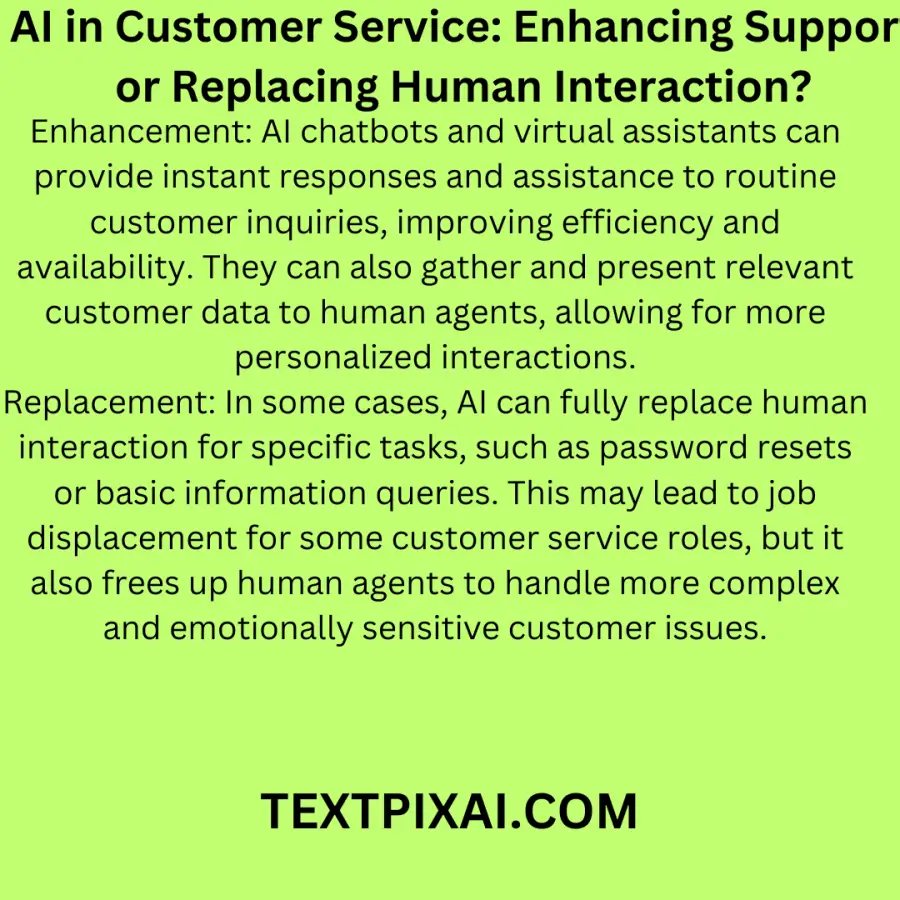
Larger companies follow the same pattern at scale: automation for routine requests, with human agents freed for complex or emotional cases.
Step 1: List your most common questions
Look through the last month of messages and write down every question customers ask repeatedly. Most small businesses find that 15 to 30 questions cover the majority of messages: prices, delivery areas, payment methods, refunds, booking changes and product details. This list is the foundation of everything else.
Step 2: Write clear, approved answers
For each question, write the correct answer once, in plain language, with any conditions. An AI assistant can help you turn rough notes into clear answers. In TextPixAI AI Chat, try a prompt such as:
Example prompt: "I run a bakery in Abuja. Turn these notes into friendly, clear FAQ answers of no more than 60 words each: delivery within Wuse and Garki 2,000 naira, same day if ordered before 12pm, refunds for damaged items with a photo within 24 hours."
Check every answer for accuracy. These approved answers become your single source of truth, so AI never has to guess about your policies.
Step 3: Publish a proper FAQ and help page
Put the answers on your website and pin them on social profiles. Customers often prefer finding an answer themselves, and a good FAQ reduces messages before they arrive. It also helps your site appear in search results for questions people ask.
Step 4: Create reply templates for each channel
Use the TextPixAI AI Writer to draft reply templates for common situations: order confirmation, delay apology, refund approved, refund declined with reasons, and a request for a review. Ask for versions in different tones and lengths, then save the best ones in your email tool or WhatsApp Business quick replies.
Step 5: Use AI to draft personal replies
For messages that do not fit a template, paste the customer's message (without personal details such as phone numbers or addresses) and your relevant policy into the AI and ask for a reply. For example: "Write a calm, apologetic reply to this customer whose order arrived late. Offer free delivery on their next order. Keep it under 80 words." Edit it so it sounds like you, then send.
Step 6: Decide if you need a chatbot
A website chatbot makes sense when you receive many repetitive questions outside working hours. If you add one, follow these rules:
- Tell customers clearly they are chatting with an automated assistant.
- Limit it to your approved answers rather than letting it improvise about prices or policies.
- Always offer a quick route to a human, with expected response times.
- Review conversations weekly to find wrong answers and missing topics.
Step 7: Protect customer data
Customer messages contain personal data. Before using any AI tool, check what happens to the information you enter. Remove names, phone numbers, addresses and payment details when you paste messages into an AI assistant. In Nigeria, the Nigeria Data Protection Act 2023 applies and the Nigeria Data Protection Commission publishes guidance; in the UK and EU, the ICO's AI guidance is a good reference. Our article Data Privacy and AI Tools: What Happens to Your Data explains the basics.
Step 8: Measure what changes
Track a few simple numbers before and after: average first response time, the number of messages per week, how many issues are resolved in one reply, and customer feedback. These show whether AI is genuinely helping. Our guide How to Measure the ROI of AI Tools in Your Business shows how to put a value on the time saved.
Where to keep humans in charge
Some conversations should always be handled by a person: angry or upset customers, complaints about safety, refunds outside policy, legal issues and anything involving vulnerable customers. AI can draft, summarise and sort, but empathy and judgement are your competitive advantage as a small business.
Customer service also connects to the rest of your marketing. For automating follow-ups and reminders, read AI Marketing Automation: Examples and a Simple Workflow, and for a wider plan see How Small Businesses Can Use AI.
A simple weekly routine
Set aside a short slot each week to review customer conversations. Add any new common questions to your FAQ, update templates that customers found confusing, and note complaints that point to a deeper problem with a product or process. Over time this turns customer service from a cost into a source of ideas for improving the business.
Related guides
Keep reading in this topic cluster:
- Data Privacy and AI Tools: What Happens to Your Data
- How to Measure the ROI of AI Tools in Your Business
- AI Marketing Automation: Examples and a Simple Workflow
- How Small Businesses Can Use AI: A Practical Guide
- Free AI Tools for Small Business: How to Choose
Frequently Asked Questions
Can a small business afford AI customer service?
Yes. Many useful steps, such as drafting replies and FAQs with an AI writing tool, cost little or nothing beyond a subscription you may already have.
Should I replace my customer service staff with a chatbot?
No. Use AI for routine questions and drafting, and keep people for complex, sensitive and high-value conversations.
Do I have to tell customers they are talking to AI?
Being open is good practice and is required in some places. Customers trust businesses more when automation is clearly labelled.
What is the easiest place to start?
List your most common questions, write approved answers with AI help, and publish them as an FAQ. Then create reply templates.
Is it safe to paste customer messages into AI tools?
Remove personal details first and check the tool's privacy terms. Never paste payment details or passwords.



